
Connecting building nodes to a network
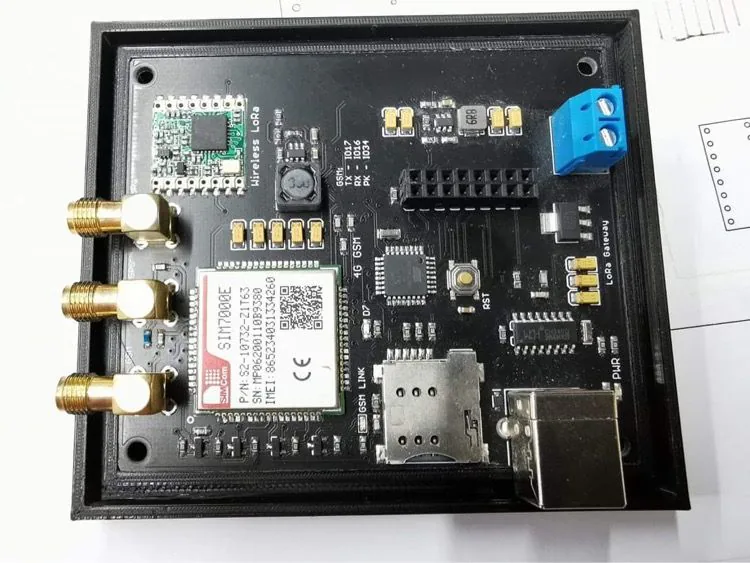
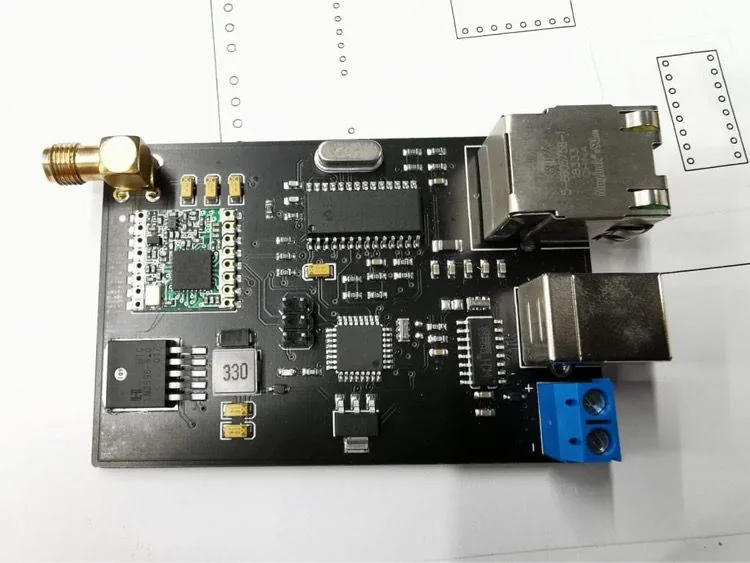
Baztech’s smart-building project includes a custom LoRa point-to-point (P2P) gateway using an RFM95W radio module. The client requested two gateway versions to suit different network arrangements: a cellular version using a SIMCom SIM7000E module and a version using an Ethernet LAN module.
The RFM95W provides the LoRa communication layer for the building’s nodes. The gateway brings this wireless communication together with the selected cellular or wired-network interface.
Two connectivity versions for the application
- SIM7000E cellular version: Uses a SIMCom SIM7000E module for the gateway’s cellular-network connection.
- Ethernet LAN version: Uses an Ethernet module for connection to the building’s wired local network.
Both versions are developed around the project’s LoRa P2P communication requirements. The supplied photos show the cellular gateway board in its enclosure and the separate Ethernet gateway board, with the radio modules and network hardware visible.
Custom electronics for smart buildings
The project combines custom PCB development with LoRa communication and network-interface integration. It complements the node-board work described in our ATmega328P and RFM95W LoRa P2P integration.
For a similar project in Malaysia, share the node locations, data to exchange, gateway location and available cellular or Ethernet connection. These details help define the board, firmware and communication requirements for the building.
Questions about this integration
Which radio module does the gateway use?
The supplied project uses an RFM95W LoRa module for P2P communication with building nodes.
What are the two requested gateway versions?
One uses a SIMCom SIM7000E cellular module; the other uses an Ethernet LAN module.
Is this a LoRaWAN gateway?
The described project uses LoRa P2P communication. It is a separate integration from our LoRaWAN gateway applications.